Mattress materials and construction
King-Size Organic Latex: Assessing GOLS Certification and Wool Layers
A king-size natural latex mattress is more than a wide sleep surface. Its material claims, certification scope, layer arrangement, wool content, and compatibility with the bed beneath it all shape what the finished mattress can—and cannot—be expected to deliver.
In a bedroom, a king mattress occupies a broad patch of the landscape: a place shared by two sleepers, crossed by changing temperatures, and subject to different needs for pressure relief and support. Yet a mattress label can make a complex object seem simple. Words such as “organic,” “natural latex,” and “wool” suggest a clear story, but each describes only part of the construction. The useful questions are more precise: Which materials are certified? Does the certification apply to the latex, the finished mattress, or both? How are the layers arranged, and what role does wool play above them?
For people comparing natural latex organic mattresses, GOLS-related documentation can help distinguish a verified material claim from a broad description. It does not, by itself, settle every question about comfort, durability, emissions, or the environmental impact of a finished product. Those answers depend on the full bill of materials, construction details, and the evidence made available by the manufacturer.
This guide explains how to examine GOLS certified natural latex claims, how wool comfort layers influence a mattress surface, and what is especially worth checking when choosing an organic latex king size. The aim is not to prescribe one ideal bed. It is to make the details legible enough that the choice can be based on construction rather than shorthand.
Begin with the whole mattress, not the headline
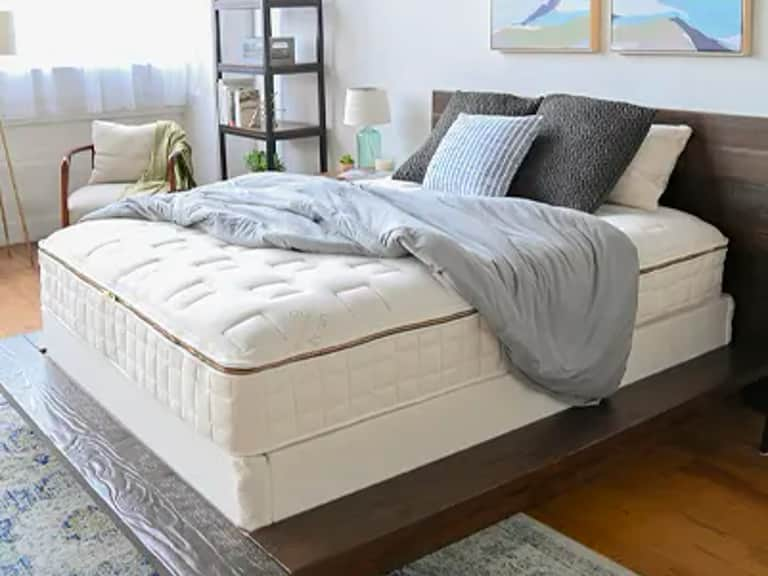
A mattress is a layered system. In a latex design, a cover may enclose one or several latex components, sometimes with wool or another fiber quilted into the upper panel. Some constructions use a single core; others separate comfort and support into distinct layers. A zippered cover may allow components to be rearranged or replaced, while a stitched cover may make the assembly less accessible.
These distinctions matter because a material name does not describe where that material sits or how much of it is present. “Latex mattress,” for instance, could refer to a mattress whose primary support is latex, or to a design that includes a latex comfort layer above another support system. “Wool layer” might mean a modest amount quilted into the cover or a more substantial separate component. The terms are not interchangeable, so look for a layer-by-layer description, including thickness and material composition where available.
For a king mattress, the construction may also vary from side to side. Some models offer one feel across the full surface; others allow different firmness settings on each half. A split configuration can be useful for partners with different preferences, but it introduces practical questions: Are the layers genuinely independent? Can each side be adjusted? Does the cover hold the two sides securely? These details are part of the design, not minor additions.
Before comparing labels, write down the basic structure: outer cover, quilted materials, comfort layer, support core, and any additional topper. Then record whether each element is removable, replaceable, or adjustable. This simple map helps reveal whether two mattresses with similar marketing language are actually built in similar ways.
What GOLS certification can tell you
GOLS is the Global Organic Latex Standard, a certification framework associated with organic latex and supply-chain requirements. In a mattress context, its relevance is tied to the latex and the way certified material is handled through applicable stages of production. A GOLS claim is most useful when it can be connected to clear documentation identifying the certified material, its supplier, and the product or component covered.
The key word is scope. A certification may apply to a latex component or to a particular certified operation; it should not automatically be read as proof that every element in a finished mattress is organic or certified. A mattress may contain latex, cotton, wool, stitching, zippers, adhesives, fire barriers, and other materials. Each has a separate material history. One certification does not necessarily cover them all.
That distinction is particularly important when a product page uses a broad phrase such as “certified organic mattress.” Ask what exactly is certified and whether the claim refers to the latex alone, specified components, or the finished article under a stated standard. If the seller provides a certificate or certificate number, check that the name, product, and scope match the claim being made. Where the certification belongs to a supplier or processing facility rather than an individual mattress model, ask how that connection is documented.
Certification is evidence, not a substitute for a complete construction description. It can support claims within its defined scope, but it does not tell you whether the mattress feels firm or soft, whether it suits your sleeping position, or how it will perform on a particular foundation. Nor should one certification be treated as an all-purpose declaration about every possible health or environmental outcome.
- Identify the certified material: Is the claim specifically about natural latex?
- Confirm the scope: Does the document cover a component, a facility, a supply chain, or the finished product?
- Match names and models: Do the certificate details correspond to the company and mattress being considered?
- Ask about non-latex materials: What are the cover, quilting, fire barrier, and other components made from?
- Distinguish certification from comfort claims: Certification does not establish a particular firmness or sleep experience.
Natural latex: responsive support beneath the surface
Latex is valued in mattress construction for its resilient response. When pressure is applied, the material compresses and then rebounds, giving a different sensation from materials that respond more slowly or retain a deeper impression. The feel depends on more than the word “latex”: thickness, density, formulation, manufacturing method, perforation, firmness, and the layers above and below all contribute.
In broad terms, an upper comfort layer is intended to influence the first impression of the bed and soften pressure at the surface. A deeper support layer helps manage how far the body settles and how the sleeping posture is maintained. These roles overlap, and the exact result depends on the sleeper as well as the build. Body weight, sleep position, body shape, and personal preference can all change how the same mattress feels.
For side sleepers, the shoulder and hip often press more deeply into the surface than other parts of the body. A comfort layer that is too firm may feel unyielding at those points; one that is too yielding may allow the body to sink more than feels comfortable. Back and stomach sleepers may prioritize a different balance. There is no universal firmness setting that works for every person, and a certification cannot answer this comfort question.
Ask whether the latex is Dunlop or Talalay if the distinction is relevant to the model, but avoid treating the process name as a direct substitute for testing or detailed specifications. The material’s position in the mattress, its firmness, and the entire layer sequence are more informative than a single label. If the manufacturer offers a layer diagram or component specifications, compare those details rather than relying only on a brief marketing summary.
Wool comfort layers: warmth, moisture, and feel
Wool can appear as batting quilted into a mattress cover, as a more substantial comfort layer, or as part of a separate topper. Its soft, springy fibers can add a cushioned surface feel, and wool is known for interacting with moisture in ways that differ from many synthetic fills. It may help manage moisture at the surface, but the overall sleep temperature is determined by the whole system: room conditions, bedding, airflow, cover fabric, latex structure, and the sleeper’s own thermal comfort.
The amount and arrangement of wool matter. A thin quilted layer will usually have a different effect from a thick wool pad. Quilting can also hold fibers in place and shape the surface, while a removable topper may be easier to air or replace but can shift if it is not secured. Ask how much wool is used, where it sits, whether it is quilted or loose, and whether the component is removable. If a product uses wool as part of its fire-safety design, request an explanation of the complete construction rather than assuming wool is the only fire barrier.
Wool can compress with use. The degree and rate of change depend on fiber preparation, density, construction, and everyday loading. A surface that feels lofty at first may become more settled over time. That does not automatically indicate a defect; it is a material behavior worth considering when setting expectations. Care instructions are equally important. A mattress cover or internal wool layer may not be machine washable, and washing the wrong component can damage the materials or affect the warranty.
Wool is an animal-derived fiber. Shoppers who avoid animal materials for ethical, religious, or other reasons should confirm whether a mattress is wool-free rather than inferring this from a general “organic” label. Some designs offer a vegan configuration, but its alternative materials and safety construction should be reviewed separately. “Natural,” “organic,” and “vegan” describe different attributes; one does not imply the others.
Reading the relationship between latex and wool
Think of wool and latex as materials with different jobs rather than competing features. Wool near the surface can change the hand-feel of the mattress, add gentle cushioning, and contribute to moisture management. Latex beneath it provides a more resilient layer whose compression and rebound help determine the bed’s support and response. The boundary between them is also part of the experience: a thicker quilt can soften the immediate sensation of latex, while a thinner cover may let its responsiveness feel more direct.
When a mattress includes both, ask whether the wool is integrated into the cover or supplied as an independent layer. An integrated quilt may make the surface feel cohesive but can be harder to alter. A separate wool topper allows more flexibility, although it can affect the mattress’s perceived firmness and may require additional maintenance. If latex is also supplied as a separate topper, the complete stack height and stability deserve attention.
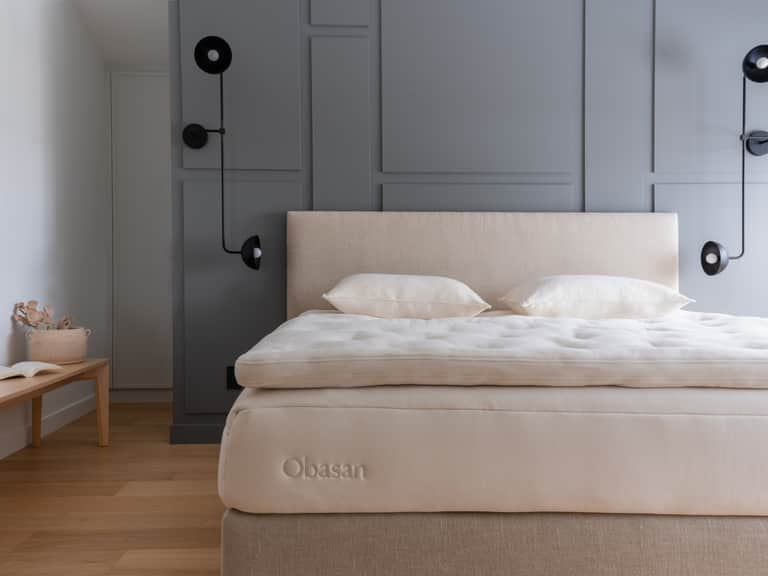
These details can be seen in the construction of the Obasan Deluxe Dunlop Latex Mattress, which is described as using GOLS-certified organic Dunlop latex, an organic cotton cover quilted with GOTS-certified wool, and an additional latex topper wrapped in wool. Its layer description also identifies a 4-inch base, a customizable zoned center, and a 2-inch soft top. This example is useful as a construction reference: it illustrates why certification, wool placement, layer thickness, and adjustability should be evaluated as separate but connected questions. The product description is not a substitute for checking the current certification documents and specifications directly.
For couples, a king mattress can provide room for different preferences, but width alone does not guarantee individualized comfort. Confirm whether the construction can be configured by side and whether the wool and cover remain consistent across both halves. A central seam or difference in layer arrangement can be perceptible to some sleepers. If possible, try the bed in a setup that resembles how it will be used at home, including its intended foundation and bedding.
Why king size changes the practical questions
A standard king mattress is commonly listed at approximately 76 by 80 inches, while a California king is generally longer and narrower, often about 72 by 84 inches. Verify the dimensions of the specific mattress, frame, and foundation before ordering; naming conventions and available configurations can vary. Measure the room, too, including doorways, stairwells, and turns along the route to the bedroom. A mattress that fits the frame may still be difficult to move into the space.
Because a king mattress spans a wide area, support beneath it matters. Check the mattress manufacturer’s guidance for slat spacing, center support, and compatible adjustable bases. A foundation that is too flexible, uneven, or poorly supported can alter how the mattress performs and may affect warranty coverage. For a heavy latex construction, assembly and handling should also be planned: multiple layers may arrive separately, but the complete mattress can still be substantial.
Weight and scale influence care. Rotating or repositioning a large mattress can require two people, especially when it has a fitted cover or separate components. Confirm whether the mattress should be rotated, flipped, or left in a fixed orientation. Many layered designs are not reversible even if individual latex layers can be rotated or rearranged. Follow the manufacturer’s care instructions rather than assuming that all natural latex beds use the same routine.
Finally, check the return, comfort-exchange, and layer-adjustment terms before purchase. A customizable mattress may offer a way to change the feel, but the process, time window, shipping cost, and eligibility can differ. For partners with different comfort preferences, those details may be as important as the initial firmness selection.
A practical evaluation checklist
Comparing organic latex king size mattresses becomes easier when the same questions are applied to each construction. Rather than relying on a single badge or adjective, record what is confirmed and what remains unclear.
- Certification: What does GOLS certification cover, and can the documentation be matched to the latex and product under consideration?
- Materials: Are the cover, quilting, latex, fire-safety components, and any adhesives or other additions described individually?
- Layer map: What is the thickness and role of each layer? Are comfort and support components distinct?
- Wool details: Is wool quilted into the cover, used as a separate layer, or included in a topper? What care does it require?
- Configuration: Can the king’s two sides be adjusted independently, and are replacement layers available?
- Fit and foundation: Do the dimensions match the frame, and does the foundation meet the manufacturer’s support requirements?
- Trial and care: What are the adjustment, return, warranty, and maintenance terms?
- Personal comfort: Does the mattress feel suitable in the sleep positions and conditions in which it will actually be used?
A clear answer is more valuable than an impressive-sounding phrase. If a claim is not explained, ask for the relevant specification or document. If the answer remains vague, treat that as an unresolved part of the comparison rather than filling in the gap with assumptions.
Organic claims and responsible interpretation
“Organic mattress” is often used as a convenient umbrella, but the term can encompass products with very different combinations of certified and non-certified materials. A careful evaluation separates the claims: organic latex, organic cotton, wool certification, textile processing, and any product-level certification are not necessarily the same statement. Certifications also have defined standards and limits; reading the scope prevents a narrow component claim from being mistaken for proof about the complete mattress.
It is equally important to keep environmental and health language measured. A certified material may offer useful assurance about defined production requirements, but no label can establish that a product is suitable for every person or eliminate all possible sensitivities. People with known allergies or material sensitivities should review the complete composition and consult an appropriate health professional when needed. A mattress guide can explain terms; it cannot diagnose a reaction or replace medical advice.
Transparency is a practical virtue. Manufacturers who identify layer materials, certification scope, care requirements, and construction changes make meaningful comparison possible. When product specifications conflict across a label, retailer page, and certification document, ask which information is current and applicable to the exact model and size. Keep records of the answers and documents, particularly when certification or warranty terms are important to the purchase.
The view from the sleep surface
Ultimately, a mattress is experienced not as a list of materials but as a surface under a sleeping body. GOLS documentation can help clarify the provenance and certification scope of latex. Wool can shape the feel and moisture behavior of the upper layers. The latex beneath can contribute resilient support. Yet the result depends on the interaction of these elements, the sleeper, the bedding, and the foundation.
For a king-size bed, that interaction extends across two sides and a broad support platform. A thoughtful choice begins with evidence—specific certifications and a readable layer map—then moves to practical fit, care, and comfort. When those questions are answered separately, the phrase “organic latex” becomes more than a promise. It becomes a construction that can be understood, compared, and evaluated on its actual merits.
Frequently asked questions
Does GOLS certification mean the entire mattress is organic?
No. Confirm the scope of the certification and which material or production stage it covers. A latex certification should not automatically be assumed to cover the cover fabric, wool, fire-safety components, or every part of the finished mattress.
What does wool add to a natural latex mattress?
Depending on its amount and placement, wool can add surface cushioning and contribute to moisture management. It may be quilted into the cover or used as a separate layer. The effect depends on the full construction, and wool may compress with use.
Is a king-size organic latex mattress automatically right for couples?
A king provides a wide sleep surface, but it does not guarantee that both sleepers will prefer the same feel. Check whether the mattress supports independent firmness choices on each side and whether the adjustment process is practical.
What should I request before making a decision?
Ask for the current certification scope, a full layer and material description, care instructions, foundation requirements, and the terms for returns or comfort adjustments. Those details allow you to compare the mattress as a complete system rather than as a collection of broad claims.